Exercises for learning to write after a stroke
Written by Amber Sunner
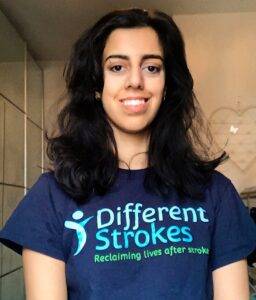
Amber is a 'two time' childhood stroke survivor, journalist and Different Strokes Volunteer. Here she explores learning to write again after a stroke
A stroke can cause mobility issues. In the case of my second stroke, I lost mobility in my right hand (the hand I write with). This meant that I developed issues with my handwriting. This is called peripheral agraphia, which means the stroke caused impaired motor control in the hand. Central agraphia is caused by disrupted language processing skills, which can also make writing hard. This article will focus on peripheral agraphia.
The seemingly simple task of picking up a pen became difficult for me, but also moving the pen to form legible letters became an exhausting chore.
The brain is capable of rewiring and recovering after stroke through neuroplasticity. Neuroplasticity is the brain’s ability to heal after a stroke by making new neural pathways.
Research has indicated that through sustained repetition and specificity, a person can help push along stroke recovery.
The stroke that affected my handwriting happened seven years ago, and with sheer practice and determination I can now write legibly, but it still takes me some time.
Physical therapists are trained in helping recover weakened muscles, like the ones in your hand – so be sure to see them and combine the exercises they tell you to do into the ones you may learn from this piece.
Tracing letters
Tracing can improve fine motor control in adults, and with the visual support of a letter guide this can be an encouragement for some people. A thick marker may be easier than a pen to grasp, making the activity that little bit easier.
After my stroke, my writing became very tiny because my muscles were too weak to move the pen, so I chose to use a large marker with a bigger tip – and I saw a dramatic improvement in my handwriting!
Grasp and release exercises
The foundation of being able to write relies on being able to hold something to write with. After a stroke, mobility issues is a common side effect. Around 80% of stroke survivors experience movement problems, but these can vary. Grasping and releasing with your hands may become harder because a stroke can change your muscle tone, making your muscles very tight and stiff or very weak and floppy.
Grasp and release exercises are imperative to help gain your strength back. For example, try grabbing objects with your affected hand, and then try to let go of the object. Start with a bigger object and then as that becomes easier try getting a smaller object. Once you are confident in your grasp and release, try the exercise with a pen and a pencil.
Stringing beads together is another crafty way to get some exercise. This will help to develop your fine motor skills. Start with larger beads, and then progress to smaller beads as your motor skills and dexterity improve.
Stress ball exercises can also help you regain your gripping ability. Get a stress ball and squeeze it in the palm of your hand repeatedly to regain that movement slowly.
Colouring
Strength and coordination of muscles are helped by colouring. Colouring is a fun activity that can help you refine this movement. It also simulates grasping and coordinating the coloured pen/pencil which mimics writing, plus it gives you a lot more freedom than being confined to strictly letters.
Writing
After becoming confident in holding a pen or marker, start writing! Incorporate it into your daily routine. Research showed that in order to promote motor recovery for a certain task you need to engage in the activity itself. After you’ve finished exercising your hands, try to write. It may be writing something meaningful to you, such as journalling about your day, or it could be something that is purely focused on the exercise itself, such as writing something out that you read. However, meaningful exercises are said to promote motor return and plasticity, according to the same research.
Brain recovery is a journey where small improvements will be seen over time. John Hopkins stroke rehabilitation specialist Preeti Raghavan M.D. says “At times the process can be slow and uncertain, and different people recover in a range of ways.”
She says: “The first three months after a stroke are the most important for recovery and when patients will see the most improvement”.
Despite recovery slowing down after this point, there is an overall trend in additional recovery after this point.
Plus, a late recovery has been recorded. One patient had a severe stroke in 1975, aged 15, that left him with no movement in his left hand. After using a physiotherapy device called a Saeboflex glove he had slow and steady improvement in his left hand, which still continues more than 37 years after the stroke. This shows that improvements can be made many years after a stroke, so don’t give up after the six month mark. This shows it’s possible that the brain can rewire itself decades after a trauma.
Keep going with your exercises, because seven years after my stroke I am still seeing improvements in my handwriting. It is becoming more legible and neater. Sometimes I still reach for a big marker for ease, but I can now hold a pen and write sentences.

Different Strokes Glasgow Peer Support Group Returns
Different Strokes is delighted to announce the return of its Glasgow Peer Support Group, providing a welcoming space for working-age stroke survivors, their families and

30 Years of Different Strokes:A Day of Connection, An Evening of Celebration
On Saturday 18th July, over 100 people gathered in Northamptonshire to mark 30 years of Different Strokes. Reclaiming Life After Stroke The day opened with

Upcoming Webinar: Looking After Yourself While Caring for Someone After Stroke
Free Webinar | Wednesday 22 July | 11:00am When someone you love has a stroke, life can change in an instant. Partners, spouses and family

Bringing the Stroke Community Together in London
During June we hosted a Community Event in London at the offices of Bolt Burdon Kemp.

Free Webinar: Medical Negligence & Rehabilitation After Stroke
Different Strokes is pleased to be partnering with specialist medical negligence law firm Fletcher’s Solicitors to offer a free online webinar for stroke survivors, families and carers.

Mike Caines Wins the 2026 Different Strokes Outstanding Contribution Award
Mike Caines Wins Different Strokes’ Outstanding Contribution Award 2026 For the past 14 years, Mike Caines has been a quiet constant behind Different Strokes. He