 March 2019, a Saturday (I think), and I’ve got the worst headache I’ve ever had, and also, an unseasonal case of the ‘flu. Someone at work came in with all the symptoms and spread it everywhere! Or maybe it was on the train – another passenger seemed to have been suffering, or maybe it was both! It actually turned out to be pneumonia due to a bacterial infection.
I get back from London – a shopping trip. The headache had been building up and so had the flu symptoms that had started on the train. I should’ve come straight back and not tried going around town. I have a lie down, but it doesn’t help. I’ve taken painkillers and drank a lot of water, but it still makes no difference. I get up again. Standing at the top of the stairs, debating if should wait until Monday and walk to the doctors’ surgery? Or maybe I should try to find the new NHS walk-in-centre? I didn’t actually even know where it was. Perhaps go to A&E? At some point while standing there I had a stroke, slumped over and fell down the stairs.
My body is all floppy because of the stroke. This means I don’t break anything, so I don’t have to worry about bits of bone puncturing lungs, etc. I’ve blacked out – fortunate – falls are less scary when you’re out cold! I come to, but I can’t move at all. After a while I can cry and call for help, but I live alone in a detached house and don’t talk to the neighbours much. I try to move to the phone but I can’t even crawl. I can’t reach the mobile phone in my pocket either. The phone rings at some point. Great if I can get to it and the caller can send help, but no luck – and I still can’t move. Really was a shame too, it was my Mum. She worked for a doctor for over forty years and she would have known exactly what to do! I should’ve called an ambulance and given them my address and postcode. But no luck – I drift in and out of consciousness, and I have some weird dreams. One was about lying on a limestone pavement in Italy under a blazing hot sun, really thirsty and annoyed that passers-by won’t give me water. I don’t actually even know what a limestone pavement is, or if there are any in Italy. I’ve been there twice, but have no Italian connections. (Later I ask a doctor if you dream normally when unconscious. “Yes” he says, so I must have actually slept part of the time!) Things carry on like this for what seems like an age. Now I have faith in God and family and friends, but I’m extremely worried.
Knock at the door. I shout for help. Voice is familiar but I don’t actually recognise it. Door bursts open. It’s the cops! They’ve kicked the door in for the Ambulance crew! Thames Valley Police don’t muck around! I try to speak and to tell them to be careful, so that they don’t fall over the junk. My house was a tip at the time, and I was in the middle of a clear-out and it wasn’t helped by me falling. I don’t think I said anything intelligible. They sit me up on the floor and administer the FAST test (Face, Arms, Speech, Time).
“Raise your arms”. Nothing. Say something. “Grunt, grunt, grumble”… “Smile”, ”Wha??! Grunt- Feck!! Wha!?”
Poor guy he’s only doing his job and trying to help me! “It’s a test!” he says. Can’t smile. “ I think you’re having a stroke – so we’ll take you into hospital”. Great! I’ll live.
I’m in the ambulance, what seems like moments before my bosses Mike and Marina say hello. They’d come to see if I was all right. Eventually, after a few days the people at work realised I wasn’t where I should be. I had my mum to thank. She had called me when I didn’t call her at the usual time on a Sunday. When I didn’t answer she called me at the office. Quentin at the next desk to mine, answers “Sorry, haven’t seen him’ It was just dawning on him I had not taken over for the overnight data load on-call stint, and I hadn’t told him. Unusual. He asks Marina if she knows, but she does not. She points out this is odd and I always lets people know if I might be late.. “. She asks to speak to Mike, the department manager whose name she remembers. Mike asks everyone where I am. “Sorry Mrs Bennett no one knows.” I had to think “WHY DON’T YOU KNOW?” She knew I was on call and so had to stay in contact with work overnight. So Mum browbeat them into checking up on me and a good job too!. It shows how important it is to have these contact routines to check on each other! I wake up in the ambulance. The paramedic tells me he’s giving me oxygen so I can breathe more easily. I see Marina and Mike (I think). How good of them to come along. I black out again. I wake up, in Intensive Care I think. I don’t recall anything now.
Wake up in an ambulance again “We’re taking you to Oxford”. They have better scanners at the John Radcliffe, than in Milton Keynes. I wake up in Oxford Intensive Therapy or Intensive Care – I don’t know which. A beautiful blonde lady introduces herself. “I’m Debbie, your named nurse. I’ll be looking after you”. Oh good – hospital! People survive strokes and I’m relatively young, 48 almost 49. It’s kind of young for a stroke but I knew it could happen to people like heart attacks happen at any age. Could take years to recover – I knew that too. Nowadays it comes as a surprise that some people don’t realise this.
I’m woken up a couple of times during the several weeks I’m there – the first time. “Please sign a release form so we can operate. Don’t worry we won’t do anything if we think it might make it worse!” “At the moment your brain is doing a good job of healing itself.” OK sounds good. Weeks later I form the judgement that the only good way to do hospital is under sedation! Second waking. Another doctor, “We want to screen you for bowel cancer, we think there may be a link between bowel cancer and stroke.” OK….blackness, and I never hear of this again.
Tunnel Of Light? At some point, I wonder if I should see a tunnel of light and hear the ancestors. I don’t, which is reassuring. Who would I hear? Probably Granddad?
“Wake up you soft bugger. Open your eyes and get back out there!” A while later I check with my cousins and my brother and they confirm that’s exactly what he’d say!
Eventually, in May I think, I wake up to be informed I’m in Ward 7 the Stroke Ward of Milton Keynes hospital (now Milton Keynes University Hospital). How long was I in intensive units? 6 weeks in each so 12 in total? Or 6 weeks in total? No-one has ever been able to tell me!
There’s also no record of anyone screening me for bowel cancer. I’m assured it never happened. Only it did. I discovered years later there is research being done in Oxford to see if there is a stroke-cancer link. I don’t think I was part of that, just a doctor thought it wise to check on me.
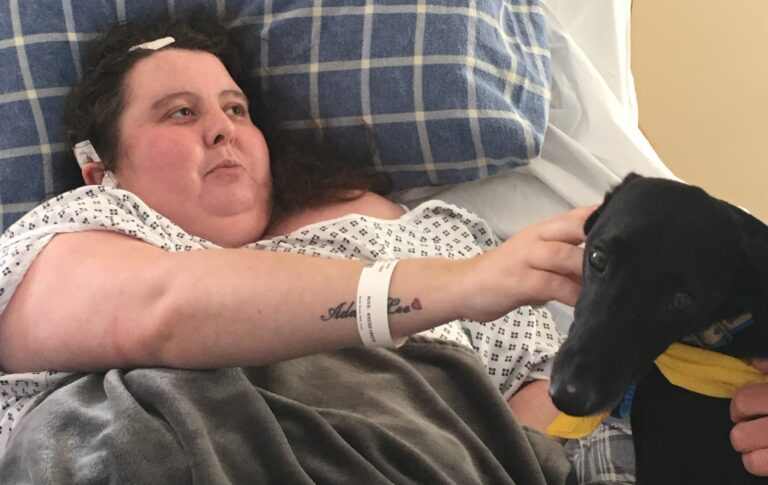
Awake. Eventually, they bring me out of sedation, and I wait around in hospital being assessed and examined and beginning therapy; physiotherapy, occupational therapy and a session with the psychologist. At one point the doctor opens the laptop and shows me the MRI scans so I can see the damage in the brain. Quite a large portion of my brain is now dead! I may still make it to 100 or 200 (it’s on the cards with advances in medicine). So what next? I start therapy but not enough. There are a lot of survivors and only so many therapists, with so many hours in the day. Although the ward staff are good, life in the ward begins to grate. There are bright moments like when Big Al (a fellow patient) went out to get married. His wife had refused to marry him until he could go down on one knee to ask. Motivation! I work in IT so I have great fun trying to make the touch screen television over the bed work properly – good therapy! Many news items and radio plays have a stroke theme! I’m told about a rehab centre called Rayners Hedge in Aylesbury which would benefit me. Ibrahim our Physio (he’s brilliant by the way, but he’s gone home to Egypt) says the programme there is really good. The doctors refer me. It takes about 6 weeks waiting, I know not why, but eventually, I am sent there. I’m one of the last patients admitted it is to be closed later that year to save money. A real shame! It was purpose-built and had done a lot of good work. I was a bit disappointed when I left because I hadn’t as much progress as I’d hoped, but my brother assures me I did progress. Some people I know seem to think it’s like the movies; you do some rehab and come out all better. Well, it ain’t like that at all!
Everything takes an age. “6 weeks” crops up time and again. A therapist tells me the NHS makes funding decisions on each patient every 6 weeks (“the funding follows the patient”). I’m discharged and sent home. It’s suggested that it takes one week to adjust and assess my living conditions, but I just get 1 day, because I surmise, the unit is being closed down.
Home. My key worker assures me that I’ll make more progress once I’m home and there is evidence for this “we wouldn’t do it if we didn’t think it’d work.” Well ok, once I’d found a bungalow to live in and had it adapted so I could do stuff more easily, I did start to make noticeable progress. This took about a year. Along the way I had support from my brother, Stan, visiting every few weeks, two social workers, and a really good carer called Paula. The NHS Early Discharge Team look after me to start with. After several months I’m transferred to another team. The therapists’ names all seem to be the same. “Does this mean I’m just transferred from one set of waiting lists to another set of waiting lists? ‘Well yes’ I’m told. I have already worked out that really I have to manage my own recovery. All survivors do. Fortunately, the Stroke Clinical Specialists in Milton Keynes are very good and they help me navigate the system. Along the way, I learn of and join the local Different Strokes exercise and support group. There I meet survivors and carers, several of whom are inspirational characters. An occupational therapist suggests voluntary work to help me get back to my job. I’m dubious but consider that the work would be useful. By chance, the Different Strokes Main Office is in Milton Keynes and I volunteer there. The rest is history as they say.
I’ve learned a lot since 2010 when I had a stroke. I’ve learned (in no particular order…)
- The meaning of the word independence. You only appreciate it when it’s gone or changes.
- A wheelchair is a great prop when you’re out collecting for charity. Also, you can stand up for dramatic effect in meetings!
- Social media is not all stupid, sometimes it can do a lot of good.
- Faith Hope and Charity. Faith gives hope and we all need hope. Charity… someone told me about Different Strokes and I discovered that it’s the best club nobody ever wanted to join!
- Never give up!
- Whatever happens, you can do something to improve your life or the life of someone you care about.
- People don’t (or more rightly can’t) understand unless it’s happened to them.
- Routine is useful and can be a lifesaver! Also routine reassures other people.
- A life-changing trauma is not the end!
- Life is good!
- Miracles do happen!
- We can be lucky as Stroke Survivors. Life can be a series of small victories.