Kris’s Story – Stroke at 43

My name is Kris and although I was born in the UK, my family and I moved to South Africa and I was raised there.  Shortly after our arrival in sunny South Africa, my father developed an illness called primary amyloidosis.  Unfortunately, he passed away at the age of 44, when I was just two years old.  My mother was pregnant in a new country and all alone, with a toddler and a new baby on the way.  She is such a such a tough lady!  As I tell her often now that she is 83, “She is OK for an old girl”.

Given the political/general unrest and the crime in South Africa that resulted from apartheid, we emigrated to the “Lucky Country” – Australia, in 1997.  This is the best move I ever made.

We moved again to the UK in 2002 as my (ex) in-laws could not get permission to stay in Australia.  I worked in the investment banking industry in London.  Unfortunately, I’d had a brain bleed in 2011, the night before a planned drive to Melbourne for my younger brother’s wedding.  I jumped in the shower as this was the worst headache in my life.  The next day I saw a GP who said it was probably meningitis or food poisoning and recommended going to hospital.  I had an MRI and was advised it was a brain bleed from a burst aneurysm and taken to hospital for coiling, where they insert a fine metal thread into the aneurysm via your groin and I was discharged after two weeks with no deficits – I returned to work and my life.  I used to work as an Audit Team Leader for the Head Office of a large retail group in Bella Vista, Sydney.

I had an angiogram after six months with news the aneurysm had regrown to a giant basilar tip aneurysm (10.2cm).  I was advised it would have to be clipped during brain surgery, but there were no surgeons prepared to perform the operation as the aneurysm was on my basilar artery and considered too risky.  This was an incredibly scary time.  After a long time searching I eventually found a surgeon willing to operate and he advised I still had the option of recoiling it, but it may regrow, and the clipping operation would then not be possible then given the amount of metal in my brain.  I was told if no decision was made, then I would die.

My ex-wife and I decided I must opt for clipping surgery.  I had just been promoted at work to a state management role, so I told my new manager and booked surgery in September 2012.  The surgeon successfully clipped the aneurysm during the craniotomy.  However, my basilar artery burst (as was feared) and I had a haemorrhagic stroke and was put in a medically induced coma for two weeks.  I lost all use of my body on the left hand side.  I am paralysed and also do not have any peripheral vision on the left hand side or central vision in my right eye; only peripheral vision.  I am what the British would call “boss-eyed“ as the pupil now faces upwards rather than forwards, like a doll with the pupil facing the wrong way.  I am now legally blind and will never drive again.  I also do not have any depth perception making shaving difficult.  

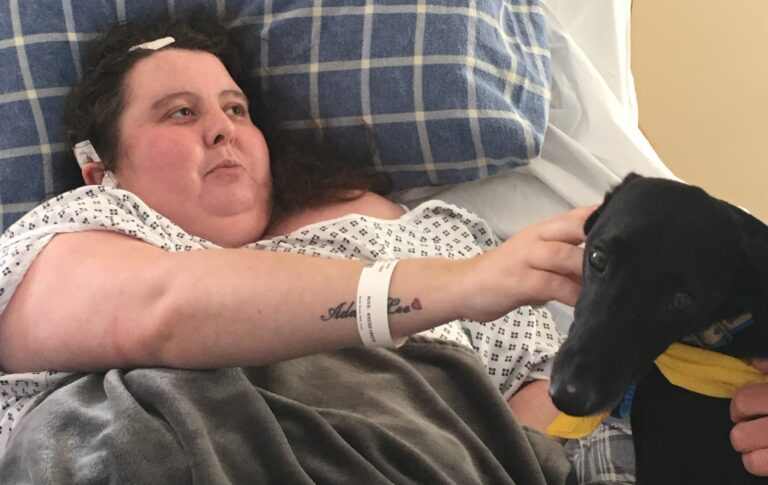
It felt and still feels like I am in a strait jacket.  The doctors told my ex-wife and our children it was unlikely I would survive, but they don’t know me!  I was admitted to a hospital and spent the next ten months in rehab.  The medical team told us that I would probably remain incontinent, was unlikely to ever walk, talk or even swallow again.  They also advised us that my memory would be poor and that the best way to describe it is like a filing cabinet thrown in the air with the files (memories) still there but in disarray.  I can vaguely remember training for my new role but did not even perform one hour in that position.

After I was discharged in June 2013 I finally returned home, but that didn’t last long as my ex-wife and I were struggling emotionally and we separated, which is not surprising given the upheaval in our lives.  She found me a flat in Pennant Hills, Sydney to live in.  At this stage, one point I want to highlight is the importance of the enduring power of attorney as you never know what is around the corner in life and you will need someone to guide you If you are not capable of doing this yourself.

After seven years, I finally realised that I had created a reasonably comfortable new life after my stroke, and I have regained some independence. I resolved to try and share the tips I found helped me in my marathon journey since my stroke with others starting the same journey (i.e. other stroke survivors or their loved ones).  It started as a simple narrative of my journey, which I found cathartic and after I reached 16,000 words, one of my carers/support workers suggested I convert my ramblings into a guide that highlighted all the points I wanted to share without the other waffle.

Interestingly, one of the few upsides of my stroke is that I haven’t had a headache since 2011, aside from the occasional ice cream brain freeze.  Weight management was an issue for me after my stroke.  By 2018: I had ballooned to between 110 and 115kg but in 2022: I am now down to 95 (halfway to my goal of 75kg).

Money management was also very important with changes in income.  Calculate if you have any surplus income and whether you can save anything. There is no point saving something and then immediately drawing it out again if you forgot something. So try to ensure you have a buffer for unexpected or unplanned expenses.

Stroke survivors are welcome to message me to request my simple plans on how I manage my money and my weight.

I have lived alone for over ten years after my stroke, adjusting to life with the use of only half my body (along with the loss of my independence).  I have dreamed of meeting a woman to share my life and laugh with.

As a consequence of living with a physical disability it was necessary for me to develop routines to ensure I could obtain the same outcome even when in a new environment, like on holiday.  This was particularly important directly after when my brain was recovering from this stroke and unable to provide me with instant solutions to problems like it used to.  As an example I can no longer drink and then simply dash to the toilet when I feel the need as I no longer dash in any form! It takes time to get to the toilet.  I have developed a routine of taking a small sip every ten minutes and found I can wait for 90-120 minutes before shuffling to the toilet.

I absolutely recognise that every stroke is different in both the event and the consequences but here are some of key points I would like to highlight:

  • Never lose hope!
  • Reclaim a much independence as you can (existence is usually NOT enough)
  • Never stop trying to stimulate your brain into waking up, so that it operates as much like it used to pre stroke.

Your donation helps others like Kris on their journey

There are 100,000 strokes in the UK each year with 1 in 4 happening to somebody of working age or younger. Different Strokes aims to promote independent stroke recovery and help these younger stroke survivors reclaim their lives.

Facebook
Twitter
LinkedIn
Facebook
X
LinkedIn
Pinterest
Reddit
WhatsApp
Email

Join Our Mailing List

This field is for validation purposes and should be left unchanged.
Name
Email(Required)
Would you like to join our postal mailing list to receive physical newsletters in the post twice a year?
Address