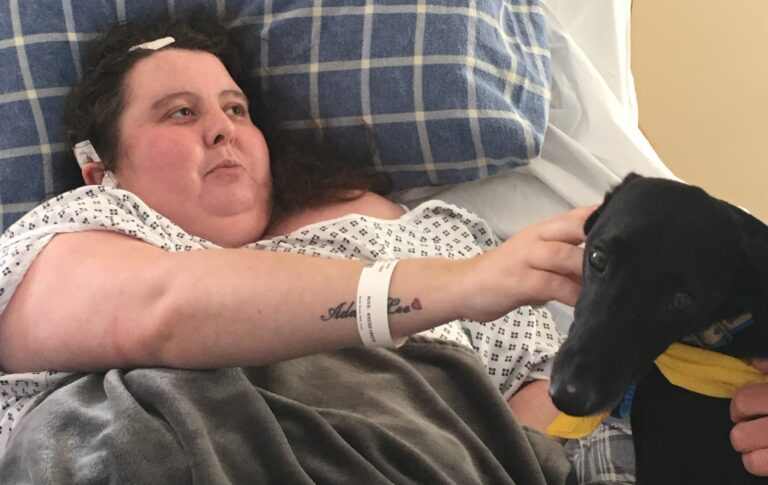
I was 29 when I had a subarachnoid haemorrhage due to a ruptured aneurysm. It was while I was alone at lunchtime, and at home. I lived in Bath city centre at the time.
I’d started a new life from scratch in England after graduating in Economics in Hungary. Life was very busy and quite stressful, trying to learn fast and build something, I didn’t yet know fully what, yet trusted my intuition.
I was demanding much of myself at a very fast pace. I tended to take on too much, which was not helpful with an underlying condition that has likely been there since birth, and I knew nothing about at that point.I had suffered with severe migraine headaches from a very young age. The severity of these increased running up to the major event. A few years before I suffered an episode that left my left side mildly weaker and I found myself falling off balance towards the left and back, especially when tired. Even two days before the stroke I was having challenging conversations around the need for further neurological assessment. I was usually delayed or refused due to my age. I remember “too young to have anything significant – it’s only the migraines” being said.
On the day I had the most debilitating headache; an excruciating pain spreading from the back of my head and throughout, I turned blue in my face and sweaty and felt very sick within minutes. I sought help immediately. Thank God for the built-in emergency buttons. In that pain – I simply could not think! I was able to move at that point and let the people from the ambulance in myself. They did not believe it was anything serious and insisted it was “only” my usual migraine. I was quite assertive that I knew my migraines, and that this was something very different and needed immediate medical attention. They reluctantly took me into hospital, saying to my neighbours how they didn’t think it was anything serious on the way out.
By the time we got to hospital within about three minutes. I could not raise my head and had a severe upper body ache and stiffness that stopped me from moving, or even sitting up. It was explained to me later that blood had entered the spinal fluid too. In hospital the CT scan very quickly established that this was a life-threatening emergency and I needed to be referred to Bristol for specialist support urgently. The doctor reinforced my assertiveness in being brought in. It was the ultimate lifesaving fast response.
The way the doctors spoke seemed a little cryptic to me, but I knew it was serious. I told my husband at the time what I wanted, if I didn’t make it out alive, since I did not have a will yet at only 29 years old. It was the worst headache of my life, I often felt sick and vulnerable, unfortunately I could not control it and it also happened while waiting for scans in waiting areas. It occurred to me that I was very young compared to others waiting in that area, and their faces were a picture when they saw me; being so young, but still jumping the queue as an “emergency”.
Recovery has been a mixture of ‘better’ and ‘worse’ days, unpredictable and slow. This is a lifetime condition, really. While I made a relatively ‘good’ recovery, I live with remnants of a physical, emotional and cognitive nature that are not visible to all, unless I’m pushed into neuro-fatigue. Then it’s rather visible and actually, I should never be pushed that far. I’m getting better at managing my energy and setting boundaries that prioritise my health.
My stroke reminded me of what mattered and what didn’t. Not for a moment did I feel a victim. I tried to find purpose in the suffering, and a way to grow through it. Mindset mattered. I surrendered, since control was out the window and I never gave up. Life has not been a walk in the park, and my stroke affected the way I think, feel and behave that does not fit a neurotypical world – whatever that “myth of normal” means.
It awoke my interest in the capacity of the nervous system and neuroplasticity. After all, I was a living example of it! It turned me into a specialist coach that works with calibrating and re-training the nervous system. Tools I use with my clients, and help myself with on a regular basis. Well over a thousand hours of experience tell me there is no such thing as neurotypical, that progress is relevant to the starting point and every nervous system is unique, depending on the experiences that wired it consistently. There is always hope, even after surviving a stroke.
I’d like to see symptoms being taken more seriously and for there not to be a post code lottery over budgetary constraints. The “statistically too young to be anything serious” has almost cost my life. I’d also like to see more tailored support post recovery, that attends to the emotional aspects of the journey, and specialist services and tools made available more widely and affordably for a better quality of life, both for survivors and their carers/loved ones. Employers also need to be more accommodating in the longer-term effects of neurodiversity. I was very lucky I had absolute support in recovery from my employer at the time, for which I’m forever grateful, but I’m aware this is not the case for everyone.
A key lesson from my stroke is how could I turn what happened to me in service of where I’m going? Embracing the growth that comes with that, and believing it is here for a purpose, even when you’re yet to find it. Be with it, allow it, and take your time.
It’s insane to think that life will go back to what it was before the event. It won’t. I suffered in silence for many long years before I reached out to seek help. I came across Different Strokes in a book that wrote about my particular condition and recovery stories. I felt ready and compelled to learn more. It’s a wonderful community built on peer support.
I feel have grown more than I lost through that fateful chapter. Over the years I’ve become a specialist coach dealing with other than conscious patterns within our nervous system and how to re-pattern and optimise these patterns for excellence and better outcomes. Looking forward, I’d like to expand my service and support to audiences with the characteristics of my own. I’d like to enable wider access that is more affordable. I’d like to help people in the way I wish I had been helped a lot sooner. It feels my lifetime will answer all the questions I contemplate daily, and I look forward to it all.
Ten years on, my thoughts to share with fellow, more recent survivors are that there may be a purpose to all this, and to look for the purpose. Exponential growth is taking place you will only understand on reflection; embrace it. This chapter is making you stronger in ways you can’t yet conceptualise. Never give up, you are here for a reason. You are already an inspiration for others for many years to come. Your resilience knows no impossible. Ride the storm, it’s testing you and making you more of who you truly are. You are a human becoming, with an endless capacity for growth and healing. Stay true to yourself, and treat yourself with compassion, no matter what. Treat yourself like you would treat a loved one. Practice unconditional love towards yourself.
Your donation helps others like Katalin on their journeys
There are 100,000 strokes in the UK each year with 1 in 4 happening to somebody of working age or younger. Different Strokes aims to promote independent stroke recovery and help these younger stroke survivors reclaim their lives.

Community Events Are Back This September – Join Us in Bristol or Sheffield
We’re delighted to announce that Different Strokes Community Events are returning this September, with two fantastic opportunities for younger stroke survivors, family members and carers to come together, connect and share experiences.
Different Strokes Glasgow Peer Support Group Returns
Different Strokes is delighted to announce the return of its Glasgow Peer Support Group, providing a welcoming space for working-age stroke survivors, their families and

30 Years of Different Strokes:A Day of Connection, An Evening of Celebration
On Saturday 18th July, over 100 people gathered in Northamptonshire to mark 30 years of Different Strokes. Reclaiming Life After Stroke The day opened with

Upcoming Webinar: Looking After Yourself While Caring for Someone After Stroke
Free Webinar | Wednesday 22 July | 11:00am When someone you love has a stroke, life can change in an instant. Partners, spouses and family

Bringing the Stroke Community Together in London
During June we hosted a Community Event in London at the offices of Bolt Burdon Kemp.

Free Webinar: Medical Negligence & Rehabilitation After Stroke
Different Strokes is pleased to be partnering with specialist medical negligence law firm Fletcher’s Solicitors to offer a free online webinar for stroke survivors, families and carers.