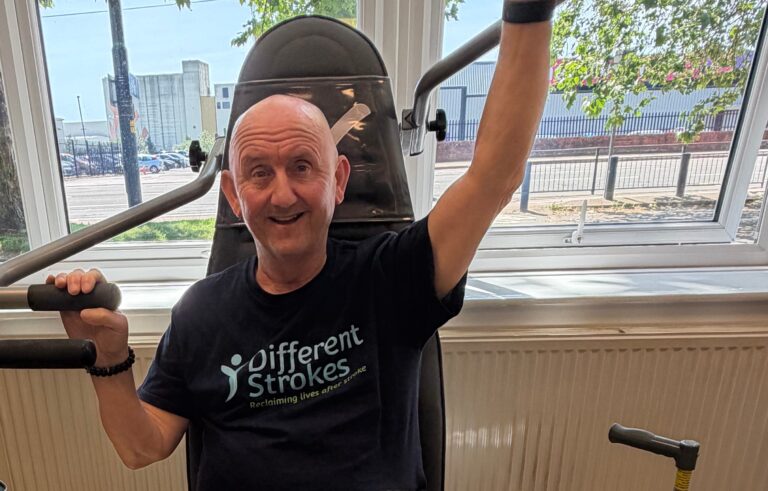
John’s Story – Ischaemic Stroke at 38
- Greg Hollingworth

The Lead Up To My Stroke

I was 38 years old when I had an ischemic stroke. I was at a music festival called Bloodstock in the Midlands. It was eleven a.m., and I was completely sober, drinking a coffee. I actually live in Southampton, so I was quite far from home at the time. It rocked my whole world. One minute, I’m drinking coffee, having the time of my life at a metal festival. Then next, there I was, on the floor of a tent, unable to move the right side of my body; unable to speak.
I was rushed to the nearest hospital, which I believe was Derby, and there I was diagnosed with having a clot in my brain. It was a terrifying time. The words that were coming out of my mouth weren’t the same words that were in my brain. I was shown basic pictures of everyday items and asked to identify them—I couldn’t. I was staring at a picture of a bucket and a ladder, and thinking, ‘What the hell is that?’ Somewhere in my brain, I knew, but I couldn’t articulate it. From there, I was rushed to Nottingham and thrust straight into the throes of a mechanical thrombectomy. A doctor explained to me what was going on. I didn’t really understand. He told me that there were three permutations: I’d wake up fine, I’d wake up with inabilities, or I wouldn’t wake up at all. It was direct, I’ll say that, but that I understood. Then a mask was placed over my face, and that was it . . .
. . . I woke up to a different world (one that I still live in), a world where my brain didn’t know how to do what was asked of it. There were simple bits of information that I didn’t know: my date of birth, where I lived, or even the word ‘stroke’. People kept asking me what was going on, and I didn’t even know how to articulate it. I woke up to a world where the right side of my body needed prompting to work. I woke up to a world where my brain was having to rewire itself.
How My Stroke Still Affects Me
And I still live here. It’s hard, it is. My brain has to take a different path now, and it’s made everything much harder.
There is probably way more to that account than I have detailed. There are probably inaccuracies. The problem is, I don’t know. I don’t really remember. . . and the same is true for large bits of my life. I don’t remember, but I don’t know that I don’t remember until someone asks me. ‘What were you doing a year ago, John. . .?’
I don’t know. There are entire chunks that are missing. And I still trip over my words. Aphasia can comes with this, and it’s not fun. It’s like I should know the word, but I just don’t. Then there is the right side of my body: it works, but I have to really think about it.
So that is me. That was my stroke. I don’t recommend it, and if there is one thing I would say, it is to look out for the signs. Speed is so important. Time is not on your side. The faster you react, the more likely it is that you’ll come out of it alive, never mind undamaged. I was fortunate enough to be with my girlfriend, who is a radiographer, and she recognised the signs immediately. She knew what was happening, knew that I needed help, and would stop at nothing to get it. But that doesn’t change the time I spent, alone, on the floor of the tent. It doesn’t change the time I spent unable to move or to get my body to cooperate. The face will go first; it will drop and won’t look right. Then the arms go, then the speech. If you notice any of these things in a person, you need to get help. There is now a procedure (and clot-busting medication) that can help. But you must get to it quickly.
So, what has the aftermath looked like? Well, if I’m honest, it’s tough. My brain works, but not the same way it used to. It’s like there are diversions in my brain. Someone has put up the little yellow signs. We can’t take the same route we used to. We just can’t. And then there is my memory. Sometimes, I feel like a video recording device that has no SD card in it. The camera is playing, but nothing is being stored. It feels like that sometimes, and it is terrifying. The worst part is, I’m 38, no one expects me to have had a stroke, and no one lets me off. I feel like I need a badge: ‘Has had a stroke. Be kind.’ That would be great, and it’s reasons like that why I’m writing this story; I want people to know.
Emotionally, I’m all over the place. I’m crying even just writing this. It’s cathartic, I’ll say that, but I’m in tears having to relive it. I’m crying. I am.
What Helps Me Keep Going
Then there is the fatigue and the pain. I’m still alive, but I am struggling. And the worst part is, having been told that I might not make it, I didn’t know how to feel. Should I be happy that I survived? I didn’t know. I didn’t know what my world was going to look like. I didn’t know if I’d ever be able to remember anything again. I wasn’t sure if I could use my words. And I’m a writer. Words are everything to me.
So, I’m grateful to be writing this. Sure, it’s been tough, but I’m still going, and you can, too. I used to hate my brain. But now I’m thinking it’s pretty incredible. It’s been forced to rewire itself. It’s been made to work in the most miraculous of ways.

I’m lucky, I guess. A high percentage of stroke patients don’t make the kind of recovery that I have made. A lot of them don’t make it.
A Potential Cause of Stroke Is A PFO

I apologise if this is a bit of a brutal account. But, it’s an honest one – and I’m begging you to be careful. You don’t want to have a stroke. I have gone back and reassessed all of my life choices, having had one. I no longer drink. I watch what goes in my body, and I consider my holistic health. But I must stress to you that it might not be avoidable.
I have a PFO (a patent foramen ovale), which is a small hole in my heart. I’m not an expert on the matter, so I won’t bore you with too many details, but it allows naturally forming clots to slip from the right side through to the left, and that spells bad news for my brain. It allows a clot to slip through the net and get into places you don’t want a clot.
And it’s a condition that affects around a quarter of us. For some of us, the hole simply does not close over during our formation process. That contributed to me having a stroke. Otherwise, I have Crohn’s disease, so I look after myself.
Then, I was fortunate. My friends look after me pretty well, and one of them made the drive (from Southampton) to Nottingham. He even bought a board game and snacks to get me to stay in the hospital post-stroke. I was desperate to leave. I pushed and pushed. I just wanted to get out. As I’ve mentioned, my emotional state was a mess. My parents even found out where I was and put a phone call into the ward. I was surrounded by people. And I am lucky.
So that’s my story. Again, apologies if it’s a hard read; it’s a tough experience. My advice (once again) is to look out (hard) for the signs of a stroke. You need to act fast. I know I’ve said it, but it’s true. And then if you’ve had a stroke, be kind to yourself. It’s going to take time, but the first few months are vital. And you need to want to beat it. You have to want to get better. I am now at the stage where it has been nearly eight months. And I feel like I’ve plateaued. The early months saw rapid progress, and this is the hard bit. It was ages ago . . . but it wasn’t. This time last year, I was still living in a four-month window of pre-stroke bliss, and I didn’t know it. As I’ve mentioned, I have Crohn’s disease, so life wasn’t easy, but it was simpler than it is now.
Why I Look For The Positives....
I am a writer, and if anything good has come from this, it is that it has galvanised me. I’d written a good book, but I was doing nothing with it. Having a stroke and flirting with death meant that I took it more seriously. And I have made significant inroads in the last six months. The weekend that just ended saw me attend a literary festival as a guest author. Next month I have a book signing at a bookshop in a different county. I am now stocked in ten independent bookshops, whereas before the stroke, it was none. So, looking ahead, I want to keep writing (now more than ever). I want as many people as possible to read my words, and I want to make a difference.
So, it’s not all doom and gloom. I have seen my life change significantly since the stroke (for good and bad), and I am still able to write. So, I am thankful.
If I were to impart any wisdom on anyone, it would be to remember that just because someone looks fine, it doesn’t mean that they are. Sometimes, I look perfect, when in reality, I’ve had a stroke, and I have an autoimmune disease. And I feel like more awareness needs to be spread about young stroke survivors. It’s not just the old who are affected by this. It can be anyone.
Since the stroke. Work has been tough for me. I work part-time in a bar, a place where you have a lot of drink orders to remember, and it is fast-paced and a sensory overload. It just is. It’s a busy bar. And I have struggled. I have had to work my way back into it. I have had to be phased in.
But, I am back to work (who have been very supportive), and I am writing again. I lost my words, and I work with words. I’ve found my words. If I can beat this. Then so can you.
I’m repeating myself, but remember: F.A.S.T. Face. Arms. Speech. Time. Definitely time, so take a moment to read that again, because the time it takes you to realise what’s happening to your friend, mother, brother, son, daughter, etc. ,is time that they might not have. So, take the time now to acquaint yourself with the signs. What you do next could be vital.
Other than that, take care of yourself and those around you. And remember that how someone looks is not necessarily how they are.
Your donation helps others like John on their journeys
There are 100,000 strokes in the UK each year with 1 in 4 happening to somebody of working age or younger. Different Strokes aims to promote independent stroke recovery and help these younger stroke survivors reclaim their lives.