Ian’s Story – Rare Stroke at 48
- Greg Hollingworth

Ian was 48 when he had a rare type of stroke, in May 2026. A blood clot formed in his brain, after an internal bleed. He lives in Buckinghamshire, with his wife and their three children. This is Ian’s story, in his own words.
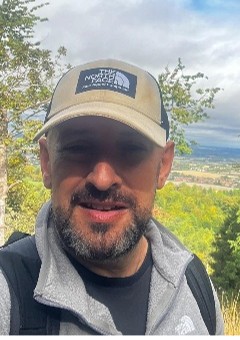
Life was good before my stroke with an active social life and strong relationships with friends and the local community which has always been important. I have been involved as a rugby coach and manager over the years for both of my sons at Aylesbury Rugby Football Club. Whether it’s helping with organising tours or car parking giving back to this community has always been rewarding and something that I have treasured over the years.
Alongside work, I have a young family at all various stages of growing up; from GCSE’s, A Level‘s and now embarking on University. Life with teenagers always keeps us busy. We are close family supported by a large group of friends across the community and beyond.
Life was hectic, but in a positive way and those relationships have undoubtedly supported the recovery I am now experiencing.
Looking back, I didn’t have any warning signs. I don’t think I have words of wisdom on how to prevent one other than to take the time to listen to your body.
What I would say, however, is allow yourself the space and time for yourself particularly when juggling multiple priorities that you care about. We all have many roles in life. Mine were; Husband, Friend, Dad, Son, Brother, Employee, Coach and Manager among others. Finding the time to get the balance right for your circumstances isn’t always easy particularly as life will no doubt ebb and flow as circumstances change. It is key that you take the space and time you need to ensure you are ready to keep both yourself healthy and be present as the best version of yourself at each of the roles you have in life.
What happened
On the evening of 13th May I was taken very poorly and an ambulance was called. I was blue-lighted to Stoke Mandeville Hospital. While being monitored I had a sudden stroke caused by a blood clot that had formed in the vein of Trolard in my brain. This caused a backup of blood which caused this vein to rupture, flooding my brain with blood. This sudden irritation caused my body to go into a massive, full body seizure. At this point, I was not aware of what was happening and was in the hands of the medical team to save my life. At one point my family were taken into the family room and told I might not make it. I was in an induced coma for around six days. During this time, I was transferred to Wycombe Hospital ICU.
It is very rare type of stroke, and we’re still piecing together exactly how and why it all happened.
Coming round
Coming out of the coma, I had to get used to walking, talking, eating, and swallowing again. My left side was weak, though I was fortunate that it was not as bad as it could have been physically. The neurological recovery is new to me and I struggle to sometimes quantify the progress I am making.
One moment stays with me. I could not communicate verbally, so I asked for a whiteboard and pen. I circled TIA on the alphabet board because I felt I’d had a stroke but didn’t know for sure. The specialist explained that it wasn’t a TIA and told me what type of stroke I’d had. Hearing it from a specialist was powerful. I finally I had confirmation of why I was there.
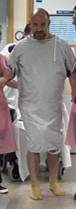
One weekend shortly before my stroke, I had read a quote “You don’t have to see the whole staircase to take the first step.” This really resonated with me, I shared it with Claire not knowing the impact this would have on my recovery over the months that lay ahead.

The most powerful moment for me was enabling me to let my nearest know that I was still there and the person laying in that bed was me. Using the white board I drew the worst picture of a staircase, Claire managed to decipher it and asked if I was referring to the staircase quote we had shared just the week before. We cried together as I knew she understood I was still Ian on the inside.
Through my determination and love from those around me, I got to the point where I could leave hospital and continue recovering at home. This felt like a crucial milestone.
Dealing with trauma
I never saw myself have the stroke, or remember what happened, but my wife did. This was a harrowing experience for her and my immediate family. We have put in place the support they need to aid their recovery. This is imperative to ensure we can all move forward as a family something I would urge others to explore as soon as they are able in their own recovery journey.
I have found it difficult to come to terms with that happened to me over that initial period and the impact the stroke had upon my close friends and family. My wife Claire pulled together a diary “the day that changed us” which whilst a difficult read has allowed me to understand and begin to come to terms with, not only the impact on me, but my closest family and friends. I will be forever gratefully for her pulling together to give me the true impact on those around me and an understand of the missing time from during the event and while I was in an induced coma.
Later, seeing my MRI scans for the first time was strangely helpful too. A specialist talked me through what had happened in plain English, and I found that really empowering as I could see the brain injury for the first time, and compare to more recent scans.
Taking the wins
While in intensive care, I knew how important it was to set myself small goals. I determined to make progress as quickly as possible. I used a whiteboard to break it down into bite sized chunks. This was empowering to wrestle some control back, at a time where everything had been taken away from me. I could see progress and share my goals with the broader medical team and my family. We could then as a group collectively celebrate progress through the challenges of recovery.
Sharing the wins with family to give hope and take those precious first steps was fundamental foundation to my recovery.
- The first win was to stand up and hug my wife and daughter on my own two feet, as a surprise. This was very emotional for us all.
- My eldest son was worried I wouldn’t want to be seen with all the tubes in, so my goal was to walk to him and shake his hand; seeing his smile and reaction was priceless.
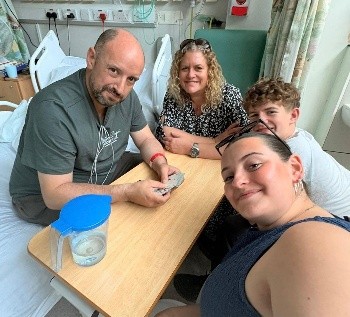
- Lastly with my youngest, I wanted to be free of the tubes, so we played cards something we always enjoyed as a family which brough a sense of normality and helped recover the dexterity in my left hand.
The focal seizures
The scariest part for me was the focal seizures which are common for those recovering from this type of stroke, as the brain attempts to rewire but occasionally misfires (neuroplasticity). They show up on my face, down my left side and around my lip, with muscle spasms. I find it hard to speak and I get anxious while I get my breath back.
The first happened after my first big walk, as we were driving home. I told my wife to pull over, and she stopped at a doctor’s surgery. We’d been told to call 999 if it happened, so an ambulance came. It was the first time since the stroke that I’d felt stroke-like symptoms, and I was scared. I’d never told my wife that before, but I told her in the ambulance which was a moment I’ll never forget.
I’ve had four in total, and the last was in August – three months after the stroke. They’re a common part of the brain rewiring itself, and I’ll be on anti-seizure medication for life. I’ve accepted that. The family have all been briefed on what to do, so when it happened again, with my daughter and parents, everyone knew what to do. That has made it easier and reduces the strain on those around me.
The neurological recovery
Physically, I’ve made good progress, and the physios have signed me off. If you saw me walking down the street, you wouldn’t think I’d had a stroke. That brings a strange sort of guilt, because I was in intensive care in May. Now, I keep my steps up with walks in the Chilterns with my dog Stanley who has been a great enabler of my physical improvement. The neurological recovery is the part nobody can see, and it’s the part I find hardest to measure.
For me, it’s mostly social. Big groups of people overwhelm me, because my brain still tries to follow four or five conversations at once. I’ve learned to let those I’m meeting with know what I’m struggling with. This is invaluable. The guides for children and young people from Different Strokes have been particularly useful with my family.

Sometimes, I’m shattered after half an hour somewhere busy or in different social settings so positioning ahead of time gives me the comfort of know those around me know what I’m dealing with.
I take a lot of notes and plan my week ahead and build up slowly, dipping into busy places and increasing it bit by bit so I can see and measure my progress.
Asking for help
On 13th May I knew who I was, at work and at home. On 14th May I was suddenly dependent on everyone around me. That was a big mind-shift. My whole life I’ve wanted to help people, and suddenly I was the one who needed help. Acceptance is hard, but the quicker you get there – the better, so you can set your own goals to move forward at a pace appropriate to your own recovery and celebrate the wins when you get them.
My next project is looking after myself and facilitating the best recovery giving time to the people who’ve looked after me on this journey so far.
My family and friends
I wouldn’t be where I am without them. My wife was the link between me and the outside world, for the huge number of messages I received. People were praying for me; even though I’m not a religious person I found a sense of comfort in it. Friends from the rugby community sent messages. The family didn’t have to cook for about two weeks because of all the lasagnas and bread delivered by loved ones.
It is only now some months later that I am reflecting and re-reading those messages and I’d like to thank each person who gave my family support during the most challenging of circumstances. Reading those messages back now is a bit like reading your own obituary, which is a strange thing to do but truly humbling.
You never know how you; your family and friends will react in these challenging times until you experience it firsthand. I am truly honoured to have those closest to me walk alongside me as I take the path to recovery.
What I valued most, once the emergency was over, were the simple messages:
‘How are you doing? Do you fancy coffee?’
Personally, they do not have to be big gestures you’d be amazed how much it means just knowing someone is with you.

What I would say to others
Give yourself time and be patient with yourself and with those around you. Be open about where you are, so they know what to do and how to help. Ask for help when you need it and hold on to hope. Life does not have to be a completely different, but you may need to tailor how you prepare. Celebrate the wins, however small they are – as it’s not just for you but those around you.
Where I am now
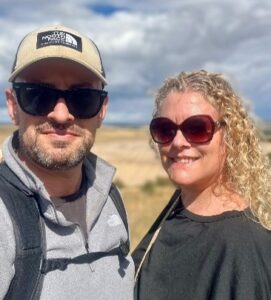
I am just starting to move into what they call the chronic stage of recovery, which does not sound nice, but that’s where I am. Physically, I want to draw a line in the sand. I’m building up to a physical challenge later in the year, a bit more each day, ending with a photo with my family on a beach.
I’m hoping to fundraise for Different Strokes along the way. The neurological recovery will continue after that, because the brain keeps rewiring, and I’m still working out what that looks like.
I still can’t see the staircase but I’m taking each step at a time.
Support Ian embarking on a challenge to run 50 miles throughout November for Different Strokes as one of two chosen charities
“This challenge of running 50 miles across November is a very emotional one for me having gone from a time where I did not know if I could walk again, to now being able to run.”

Make a smile lottery is a weekly fundraising lottery. A fun and exciting way to help Different Strokes raise vital funds that will secure our future.
It only costs £1 per play, and you can choose to play every week or whenever you feel like taking a chance and doing something good. For more information click here.