After only a minute or two, I remember laughing then I had the most unbelievable, excruciating pain behind my left eye that lasted a few seconds then stopped. Iswitched off the camera and microphone and I sat there for a few seconds thinking ‘Gosh! That really was quite something!’. Then a more normal headache started but was quickly growing stronger. Still feeling shocked by the strange headache, I felt I should go and lie down rather than stay sat at my desk.I picked up my laptop to take it upstairs so that I could carry on listening in to the meeting. In hindsight I should have left it there and sought help, but as far I was concerned, I just had a strange headache and needed a rest.
By the time I reached my bedroom I felt weak and collapsed onto my bed. I stayed in the same position I fell into as I then couldn’t move at all. I remember my neck was in an awkward, painful position but I just didn’t have the ability to get more comfortable.
I couldn’t move or shout to get help. I could hear my husband on a video call in the next room, so near yet so far, but I couldn’t make any noise to get his attention. I had my phone with me and wanted to call him or call for an ambulance, but I just couldn’t do anything!
Meanwhile, the work meeting was still going on through my laptop next to me and I could hear odd bits of conversation, but I was drifting in and out of consciousness and not able to follow it. Everything seemed very slow.
My black Labrador was by me the whole time from my lunch break and had followed me upstairs and realised something was wrong and started to fuss. After a while I was very relieved to hear that my dog had been a bit active outside the closed office door where my husband was working. I heard him end his call and come out saying to the dog ‘what’s all the fuss about?’. He soon found his way to me and I managed to say, without moving my lips,
“I can’t move”.
He offered me some paracetamol, but I was unable to take it and he quickly knew it was serious, asking if I wanted an ambulance and I somehow managed to say
“Yes!”
It was a long 1 hour 40min wait for the ambulance, but understandable considering we were at the height of a pandemic and the NHS was incredibly overstretched under peak pressure. Once the ambulance set off, I suddenly felt sick (a little known but common symptom to look out for) so the driver stopped whilst I was sick into a sick bag that was at the ready. The ambulance set off again and I closed my eyes and know nothing more of the journey to University Hospital Wales, or any of my time in A&E, or my transfer to the high dependency unit.
We were in a period of strict visitor restrictions, so I was on my own. I wasn’t aware at the time but have since learned that an emergency CT scan was performed, and they could see I had suffered a bleed on the brain. This led them to carry out a subsequent MRI scan and digital subtraction angiogram (DSA) looking for any aneurysms or abnormalities in the blood vessels that would identify any urgent treatment. There was too much blood obscuring the view that they couldn’t identify the kind of brain haemorrhage at that time.
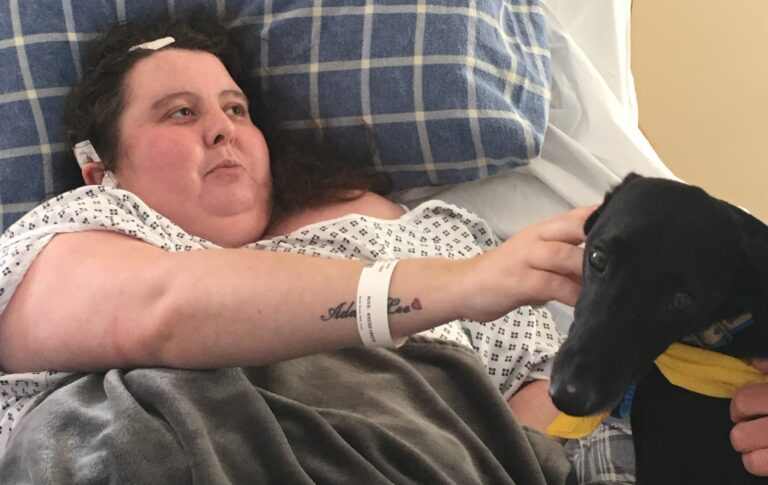
Late afternoon on day two I woke up in a hospital room on my own. Doctors, nurses and cleaners were in and out, but I was very grateful for the peace of a quiet room. My brain and neck (the blood disperses into the spine) were in a lot of pain. Any noise was overwhelming (each time I slightly moved a machine would beep until someone came to sort it out) and I could hardly open my eyes, due to light-sensitivity. I managed to send a text message to my husband to tell him I was very, very hungry – I hadn’t eaten for over a day. Then I went back to sleep for around two days. All investigations came back negative – they couldn’t find anything at all wrong, apart from a lot of blood in places that it shouldn’t be.
The scans showed I’d suffered an extensive bleed in the perimesencephalic area and I was diagnosed with a spontaneous non-aneurysmal subarachnoid haemorrhage. When the doctors told me my diagnosis, I wasn’t really ‘with it’ but I couldn’t believe I’d had a stroke. I was 41, whilst the majority of strokes happen to people over 65, and I don’t carry any of the risk factors of a stroke and had no warning. It didn’t, and still doesn’t, seem real.
All my thoughts from the very start of my recovery have been just how lucky I am to have survived rather than unlucky to be in this position at all. I have learned a vast amount about the brain and strokes over the past year. I believe the survival rate of a brain haemorrhage is just 26.7% and of those who survive around half are left with severe brain damage and disability. Around 15% of strokes are due to bleeding in or around the brain, haemorrhagic strokes, as opposed to 85% ischemic strokes. 5% are subarachnoid haemorrhages, referring to the layer in the brain of the bleed and of this 5% most are due to brain aneurysms and in rare cases diseases or blood vessel malformations. Mine was none of these: a rare and mysterious kind of stroke that I think makes me a rare gem. I’m no more likely than anyone else to suffer a stroke again.
I’m incredibly lucky that all the right actions were taken every step of the way from my faithful dog, my quick-thinking husband, the paramedics, A&E, all the NHS staff in the hospital. This led to the quick and correct diagnosis so that I was in the best place I could be without delay. Thank you NHS !
The three key messages I want to share are;
- That stroke can happen to absolutely anyone at any time
- The BEFAST message Balance, Eye sight, Face, Arms, Speech, Time (to call 999)
- That every stroke is different. I didn’t have the most known symptoms like one-sided weakness or loss of control, so it was difficult to recognise. Reading my stroke survivor story hopefully raises awareness and helps identify some lesser-known clues.