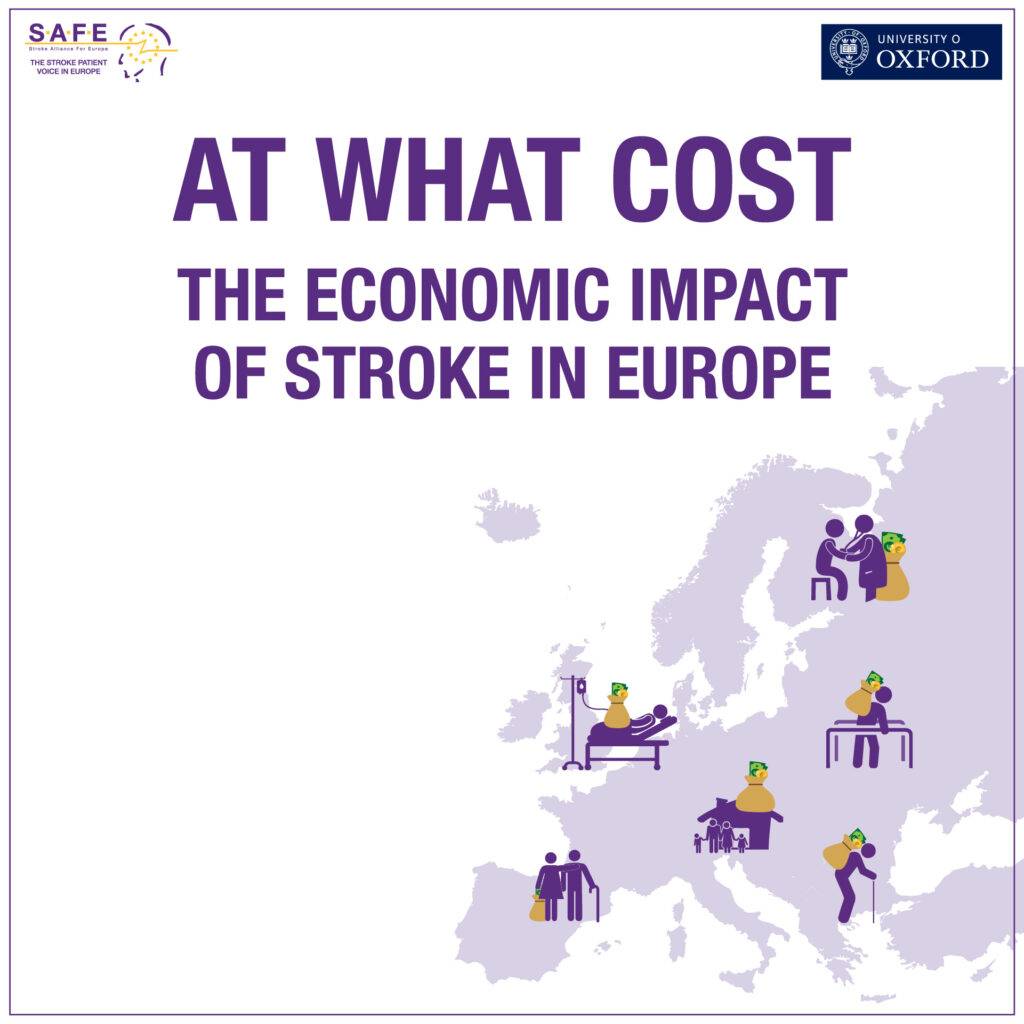
New research published today (9 November 2020) shows future costs of stroke care in Europe could increase to €86 billion in 2040 if countries fail to invest in stroke prevention, treatments and rehabilitation.
The study was commissioned by the Stroke Alliance for Europe (SAFE) and undertaken by the heath economics team at the University of Oxford, England, pre COVID-19.
‘At What Cost, the economic impact of stroke in Europe’ adds to the existing evidence that shows stroke care is woefully underfunded and needs urgent investment in the UK.
Lead researcher, Dr Ramon Luengo-Fernandez says, “The research was completed before COVID-19. Since the beginning of the pandemic, health services across Europe have been diverted away from non-infectious conditions, including stroke care, therefore we feel that the projected costs in our report are likely to be even higher.”
The study included all stroke-related costs that occurred in the EU countries plus Iceland, Israel, Norway, Switzerland and the UK.
Report findings show for the first time the cost of stroke along the whole stroke care pathway, including not only direct healthcare costs but also the costs of informal care and productivity losses due to disability or death from stroke. The study provides scientific projections related to stroke costs for the next 20 years.
In 2017, 134,979 people suffered a stroke in the UK, 992,413 lived with a stroke, and 40,054 died due to a stroke.
The full cost of stroke in the UK is 7.47 billion euros. According to the research, this is set to rise at least 50% in the UK by 2040.
In addition, the report looks at three interventions which are in the latest stroke guidelines – the treatment of atrial fibrillation to prevent stroke, mechanical thrombectomy (the clot retrieval from the blood vessel in the brain) in the acute phase of stroke and community-based rehabilitation after stroke. The research shows that no matter at which point in the stroke pathway you intervene – prevention, treatment, long-term care – there are improvements in patient outcomes and cost savings.
The number of new strokes and the number of people living with stroke is set to rise due to ageing population in Europe, as age is the biggest, non-modifiable risk factor for stroke.
“This research will help the UK to find solutions to help us reduce the burden of stroke and future proof our healthcare system. We call on the UK government to ensure that stroke care is a priority in the UK, to help save more lives and reduce future costs”, says Austin Willett, CEO of Different Strokes
SAFE’S Director General, Arlene Wilkie adds, “Health systems across Europe have been left crushed and broken by COVID-19. Stroke is preventable and it is crucial that we invest in care and support that can respond to the current and future needs of stroke survivors.”