Different Strokes Glasgow Peer Support Group Returns
Different Strokes is delighted to announce the return of its Glasgow Peer Support Group, providing a welcoming space for working-age stroke survivors, their families and


2013:
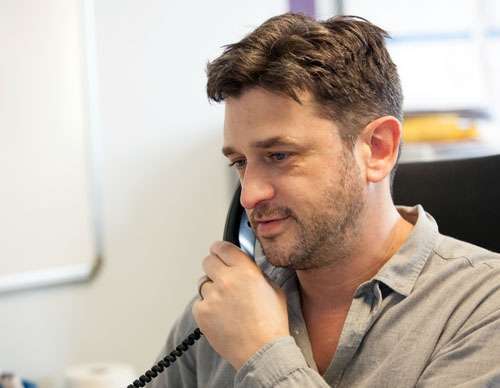 “I’m excited to have the opportunity to thank Different Strokes for giving me something more useful to do with my time than I thought I’d ever be doing. Whilst I’ve had the pleasure of speaking to many people who’ve rung the helpline. I’m sure there are many who are unaware of why I volunteered and now work for Different Strokes and take it so seriously.
I had a stroke as a result of a car accident in 2004 – I was a pedestrian hit at high speed on one of the dual carriageways, yards from my old home. I survived a traumatic head injury, which resulted in a bleed to the brain. I understand I was declared dead at some point and had to be resuscitated, albeit in a coma, unable to eat or breathe without machinery.
Frankly, I might as well have been comatose for several years as it took years before my brain seemed to recover enough to trust itself with emotion. I’d gone from having a practically faultless memory to having an almost textbook head injury recovery.
I’m really not sure I’ll ever know how much my memory impairment is a result of the fact that ‘life’ at the time (if you can call it that) was so unbearable that your brain just shuts it out or how much was a result of my brain being physiologically incapable of retrieving new memories due to the ongoing amnesia I was suffering.
They had to tell me every day – and for months – you’re 30 in a year and a bit – you’ve been in a car accident and you’re training to be an accountant.
My period of retrograde amnesia meant that I’d completely forgotten having moved cities, changed careers, having been hospitalised for months and even having a dog. I’d like to say that seeing my dog again brought back memories but I was actually that confused during my 3 months of post traumatic amnesia (the time until a more regular understanding of day to day memory becomes possible) that I remembered none of this even when it was put right in front of me.
Being driven to a home I’d apparently moved to was a bizarre experience. If it wasn’t for the fact I recognised items and books with my writing in then I wouldn’t have believed this was where I lived. Typing this now reminds me I still don’t choose to retrieve memories of that time without good reason because it’s really just too painful.
It’s difficult to believe how I managed to keep going during that time when life was planned out one hour at a time, religiously following a prompt from my mobile phone or wall chart to inform me what I needed to try to accomplish. When you slowly, and I stress very slowly, put one foot in front of the other, eventually it gets that little bit easier. At one day at a time, you don’t realise the progress you are making. If damage to your brain doesn’t make you learn patience, then nothing will – I’m sure most stroke survivors can empathise.
After the period of retrograde amnesia, I had the most delightful experience I’ve ever had and it’s difficult to both explain a slight physical high and just the overwhelming nature of having a year or two of memories suddenly become accessible within a matter of about 24 to 48 hours. In retrospect, it seems like something from a cross between a science fiction film or a true movie and if I hadn’t experienced it personally, I’d struggle to even believe it was somebody’s genuine experience.
Thankfully I learned quite early on that ‘if you don’t laugh you’ll cry’. I’ve no idea how long ago it was that I took down the huge notice on my front door ‘Make sure you’re fully clothed before you leave the house’. The fact that nobody complained that the madman down the road was putting his bins out naked again was small mercy for the fact I hadn’t realised I had been doing it for God knows how long. I needed the reminder since I still have mornings when I wake up completely blank and have to go back to square one.
I also lost the majority of my sense of touch. The best way to explain it is that it’s like your whole body is in a glove or it’s like trying to get something out of your pockets with gloves on. This has its benefits but you soon realise how dangerous it can be. The fascination of learning what burning flesh smells like wears off quickly when you realise it’s your own after picking a red hot tray out of the oven without feeling pain.
When I came to decorate my flat after finally managing to live independently again, it wasn’t much of a contest which of 2 items to place on my wall: my masters degree in Biochemistry from Oxford University or the gift from the Rayners Hedge facility in Aylesbury where I had my longer-term care – a pillowcase signed by the nurses who were patient and kind to me during that time. That pillowcase sits with pride of place framed on my wall and reminds me I bothered to get off my backside to try and change my own life for the better.
I could look back on my life and say ‘poor me’ but frankly I wouldn’t change any of it or I wouldn’t be the person I am today. I’d often tell myself that rather than focus on what I couldn’t do, to rephrase it and simply just add the word ‘yet’. I may not have the life I imagined, but several years ago I decided to go to bed happy. I’m glad I learned that early on, rather than allowing myself to wallow in self-pity for too long. To me, it’s all about perspective.
I often remind myself of the best bit of advice I was ever given: ‘if things don’t change, then they stay the same’. In at least one Eastern language they use the same word for “crisis” and “opportunity”. Sometimes it’s difficult to see a silver lining but it’s unlikely there isn’t one to any cloud.
A quote from Helen Keller that helped me in the early days when things were changing and beyond my control was: “When one door of happiness closes, another opens; but often we look so long at the closed door that we don’t see the one which has opened for us.”
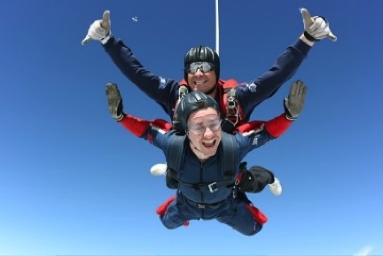 I’m so grateful to have the opportunity to volunteer at Different Strokes and my whole outlook on life has changed as a result. I’m also grateful to have had the privilege of working with Peter (Shave), the volunteer we sadly lost a few years ago. If he caught me getting all ‘poor me’ about anything, he’d simply look, smile and say ‘But you’re alive!’ I’m sure he wouldn’t mind me reusing the phrase he used about Different Strokes which was that volunteering here gives us an opportunity to turn what most might see as a liability into an asset and to see how our experience might benefit others. Raising over £1,000 by jumping out of a plane in 2011 was a fantastic experience and my way of giving back and saying thanks. If you’d like to do something similar or know anyone that might want to have that experience too all they’d have to do is commit to a minimum donation amount and for more information please see the Fundraising section of our website here.
I now photograph and put on Facebook everything I eat. It stops me getting overweight – stops me losing weight from lack of self care – but importantly it shows people who access the Internet that I’m looking after myself. Also they remind me to eat if I forget.
Finally, thank you to everyone who’s helped me, especially family and friends, the caring organisations I volunteer and now work with and a few health care professionals whom I can’t thank enough.
Update for 2020
Since I last wrote this, I was ecstatic to be still enjoying the job I applied for at Different Strokes the same month that I passed my driving test and am now even still enjoying driving! I did actually forget that I had bought my first car from my parents and did wonder why their car was on my drive, just after I’d passed my test! It took a while but I worked out that it was now my car and was initially a little concerned that I had been given a driving licence, especially since I didn’t even remember ever buying the car!
However, I was reliably informed that procedural memory (I understand this as “Monkey see, monkey do… 🙂 ) is the most reliable form of memory. As soon as I put the key in the ignition, and having had driving lessons for over a year (with a very patient instructor), it all came flooding back to me and I really enjoy driving now.
However, I was still feeling very much alone and felt I wanted to share my life with someone. I assumed that having a stroke at working age, displaying a high level of disinhibition and the additional symptoms that can come with the level of head injury I sustained, meant I thought I would always be alone. My new husband, Asa, has told me that the way I confronted my injuries, got on with looking after myself, continue to (very) slowly get better and just get on with it was, actually quite an attractive feature in its own right – that came as a surprise! To help me cope with everyday life Asa has put in place a Red Card/Yellow Card strategy to ensure that I can mix in social situations more appropriately. If only he knew what went on when he wasn’t around!
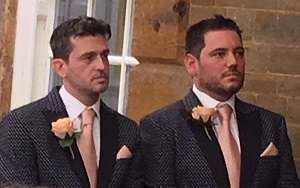 I even got married two years ago to a wonderful man with a family that has completely accepted me and all the challenges that are sometimes apparent. I feel privileged to extend the wonderful and supportive family that I already have and know that they all want me to succeed in life.
My wedding day was the best day of my life! Just to prove how much of a good time we all had celebrating, here is a link to our first dance that I’m sure I’ve bored our Facebook ‘closed group’ members with already but have a look here: https://www.youtube.com/watch?v=N6mLu17WGlA
I’m really excited about how Different Strokes has grown in the time I’ve been here, the support I’ve had from the ‘Private’ Facebook group and the staff and volunteers, and the friends I’ve made in my time here. I can’t believe it’s been 16 years of recovery, but I’m glad learned early on we’ve only ever got the day we’re in and I still try to make the best of each one that I’m alive!
My main responsibility in the office is being the main admin for the ‘Private’ Facebook group and do request to join if you are a working-age stroke survivor or immediate family member here if you’re not a member already.
Different Strokes is delighted to announce the return of its Glasgow Peer Support Group, providing a welcoming space for working-age stroke survivors, their families and

On Saturday 18th July, over 100 people gathered in Northamptonshire to mark 30 years of Different Strokes. Reclaiming Life After Stroke The day opened with

Free Webinar | Wednesday 22 July | 11:00am When someone you love has a stroke, life can change in an instant. Partners, spouses and family

During June we hosted a Community Event in London at the offices of Bolt Burdon Kemp.

Different Strokes is pleased to be partnering with specialist medical negligence law firm Fletcher’s Solicitors to offer a free online webinar for stroke survivors, families and carers.

Mike Caines Wins Different Strokes’ Outstanding Contribution Award 2026 For the past 14 years, Mike Caines has been a quiet constant behind Different Strokes. He