Ellie’s Story – Ischaemic Stroke at 24
- Greg Hollingworth

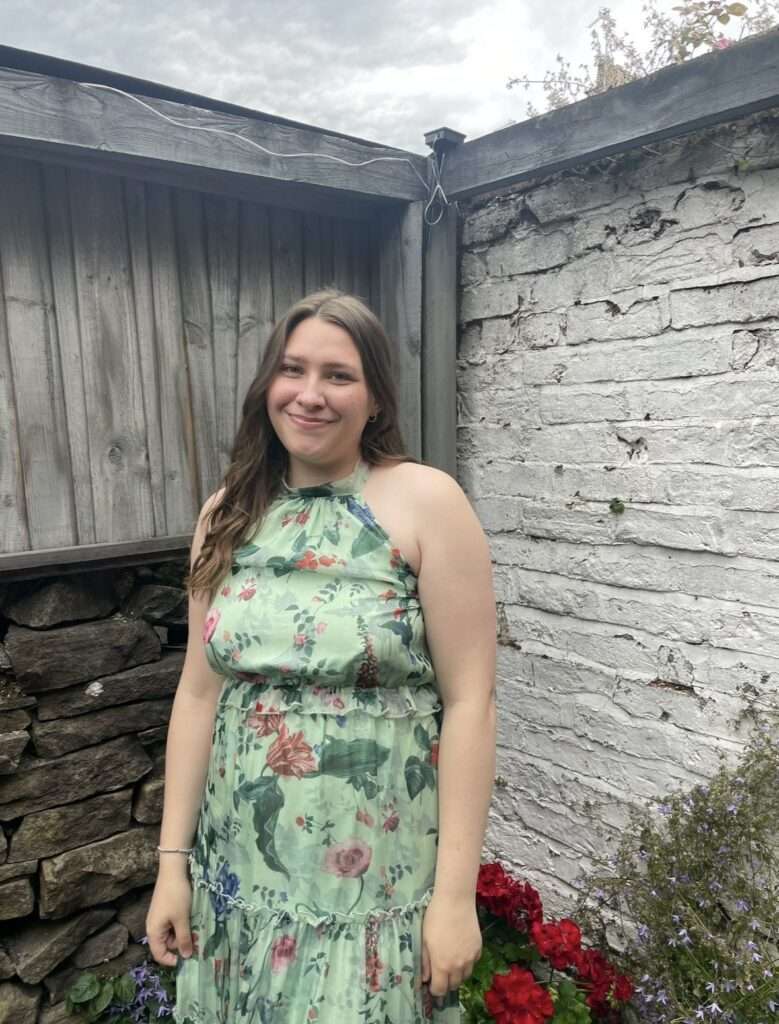
In April 2024, it felt like everything was coming together. I was 24, and I’d been employed as a recent graduate for around six months as a health psychology research assistant. It was a really exciting time as I was making plans with my partner for buying our first house, I was starting to make good friends in a town that I had only recently moved to, and I was about to go on my first solo holiday hiking across Mallorca. That was all until I had my ischaemic stroke.
My experience of stroke
It was a Friday evening in early spring, work was done for the week, the sun was shining for what felt like the first time in months – so my partner Tom and I had decided we’d go out for pizza and a glass of wine for a treat. When we got home at around 8pm, I felt rather tired so decided to take myself off to bed for an early night. As I was brushing my teeth, my vision suddenly blurred and I couldn’t see. I shouted to Tom, who had to help me walk along the corridor to our bedroom.
I felt as if I was about to fall off a cliff as I couldn’t feel the floor in one foot. It was then that he noticed that half of my face was drooping. It was only when I replied to him saying he was going to call an ambulance with “don’t be silly, I feel fine, I’m just tired”, when I realised that my speech was also slurred.
The details of what happened next are slightly blurry for me, even eighteen months on. The 999 call handler initially suspected carbon monoxide poisoning, so we had to sit outside our home to wait for emergency services. I was sitting on the pavement outside when I was in the thick of my stroke. It was honestly terrifying the feeling of being aware of everyone around you talking about the situation and hearing your partner panicking, and not being able to respond. Luckily, my stroke only lasted for around 20 minutes. When the ambulance eventually showed up after the first responder paramedic and fire service, I was obviously shaken up by the experience. Once I got to A&E, unfortunately because of my age I don’t think stroke even crossed the hospital staffs’ minds, it felt like they assumed that I was intoxicated or on drugs. However, several hours after being admitted to hospital I had a CT scan, which showed a very small bleed on my brain, but this wasn’t conclusive that I had definitely had a stroke.
What followed was a long, confusing week of tests, uncertainty, and doctors trying to understand what had happened. My family brought me countless books and magazines to keep me busy, but I honestly didn’t feel like I had the capacity and focus to read. At one point the doctors discussed performing a lumbar puncture to explore the cause of my potential stroke. This was something I struggled to take in, but which frightened Tom and my family. Luckily it was decided that this wasn’t needed, and eventually I was discharged after a week in two different hospitals, still without any answers. Being sent home with no explanation was incredibly scary.
About 10 days later I was sent for an echocardiogram, which revealed that I had a patent foramen ovale (PFO) – a small hole in my heart. Since I had no other typical stroke risk factors, this became the leading theory for my stroke, and so steps were made to put me on the waiting list for PFO closure. We later made the connection that I had been prescribed tranexamic acid by my GP for heavy periods that I was experiencing at the time. This medication thickens the blood, and so a combination of this medication and discovery of the PFO were assumed to be the cause.

Returning to “normal life”
Going back to normal life was one of the most difficult parts of the whole experience. As a recent graduate I returned to work three weeks after my stroke, part-time, but I felt like I’d lost all the skills I’d spent months building – which was frightening. I’m incredibly grateful to my employers for being so understanding and supportive. However one of the things that I found most difficult at this time was managing going to work alongside everyday tasks; like grocery shopping and cleaning. All of this felt exhausting at this point, and I leaned heavily on Tom for months. It felt like I had no energy at the end of the working week to do any “fun” things for myself. This is when I discovered pacing and tried to make this a part of my everyday practice. I also eventually started counselling to help me make sense of the whole situation, which really helped, though I had to pay privately as the waiting list for NHS talking therapies was over a year long.
Gradually over the next couple of months, I started feeling less fatigued, more capable, and more ‘like myself’. My PFO procedure was performed in November 2024, which strangely felt like I was closing a massive chapter of everything that had happened since my stroke – and which felt a bit emotional. It was a whirlwind day, I was in and out of hospital in a day, but it felt reassuring that it had now been managed. I was surprised how quick after the procedure I started to feel better. I had been prepared to be resting at home for a whole week, but recovery afterwards felt much quicker.
I’m now eighteen months post-stroke, and it’s been a year since my PFO occluder surgery. I can honestly say that I feel the best that I ever have since the stroke, and it feels like my journey is only going up from here. I still have the occasional day where fatigue hits and I need quiet time alone, but those days are far less frequent and I am able to better manage my energy levels.
What I’d say to others in recovery
Looking back on my journey, the biggest message I’d share is: please don’t be so hard on yourself. At times during recovery I could be my own worst critic – comparing myself to others, minimising what I’d been through, convincing myself I should be “over it” by now. I can see now that this mindset was exhausting and I was being unfair to myself. Recovery isn’t linear and doesn’t happen overnight. Progress takes time, and setbacks don’t mean failure no matter how demoralising they feel. What really helped me was re-shifting my focus: look at how far you’ve come – not how far you think you have left to go.
Looking forward
Today, I feel even more hope for the future than when I had my stroke. One positive thing I think I have learned with having experienced all of this, is the ability to re-shift my thinking patterns away from the negative and to find the positives. Tom and I bought our first home in July, and I challenged myself by going solo travelling in Italy for the first time this summer. In May, I’m running the Edinburgh Marathon for Different Strokes (eek!). It feels hard to believe that after months of chronic fatigue I’m in a position to take on something like this. More than anything, I hope to raise awareness of stroke in younger people and help build better understanding of how deeply it can affect our lives. It’s taken me a long time to truly make peace with my situation, but I feel thankful that I am able to tell others my story and raise awareness. During recovery I read loads of stroke survivors’ stories and their experiences, which really helped me to make sense of my own situation and the steps that I could take to help myself in recovery, so I feel honoured to be able to share my own story

Support Ellie’s Edinburgh Marathon in 2026 for Different Strokes
During my recovery, the advice and support from Different Strokes were invaluable. I am running this marathon to give back to the charity, to raise awareness of stroke in younger people, and to show how far recovery can take you. Completing a marathon was never something that was on my bucket list, and at the time of my stroke it certainly wasn’t something I ever thought I would be able to do in the future, which is why this challenge means so much to me.
If you are able to donate, no matter how small, or even just share this page, I would be so grateful for your support.