I called my partner, who also works from home, just 10 minutes away by car. She dropped everything and got in the car. My colleague kept the work call open until she was happy that someone was on the way to me – I cannot thank this lady enough for her vigilance and the speed at which she acted. As I was waiting or my partner to arrive, I called 111 for advice and was on the call when she arrived – at this point I began to feel a bit more relieved, if a bit confused. The advice was to go to A&E to be checked out as soon as I could, and if possible, to avoid waiting for an ambulance. As I mentioned above, my birthday was approaching. We had plans for the evening – a birthday meal with family – and then a weekend away in London. We quickly set about rearranging the evening, calling in help from grandparents to look after each of our daughters, and then set off for the hospital.
We firstly went to A&E at Wigan Infirmary, the closest major town to where I live, but following a long wait there, a brain scan revealed that I should be (quickly) taken to Salford Royal Hospital just outside Manchester – a journey of thirty miles – which has a specialist neurosurgery and stroke unit. As hard as it was to be alone again, I urged my partner to go home and rest at this point. I didn’t see any point in her coming in the ambulance to Salford and then being stranded there alone herself. So, we parted, and I was blue-lighted all the way there. I had some time to reflect on that journey. I was already painfully aware of the expertise at Salford, after they’d treated my Dad eleven years before, when he underwent elective surgery to remove a benign brain tumour. It turned out that Wigan just didn’t have the expertise or facilities to provide the urgent care that I needed, so I felt confident that I was going to the best place. I also knew the grim reality, following my Dad’s experience of brain injury, that my life was unlikely to ever be the same again. I had nothing else to do, so I began re-planning my life in the back of that ambulance and in the triage ward that followed. I had been a fit, healthy and active man before my stroke, but I knew that was going to change. I also lived alone, following separation and divorce three years earlier – and I knew there would be changes to make there too. There was a lot to consider, but I had plenty of time to myself.
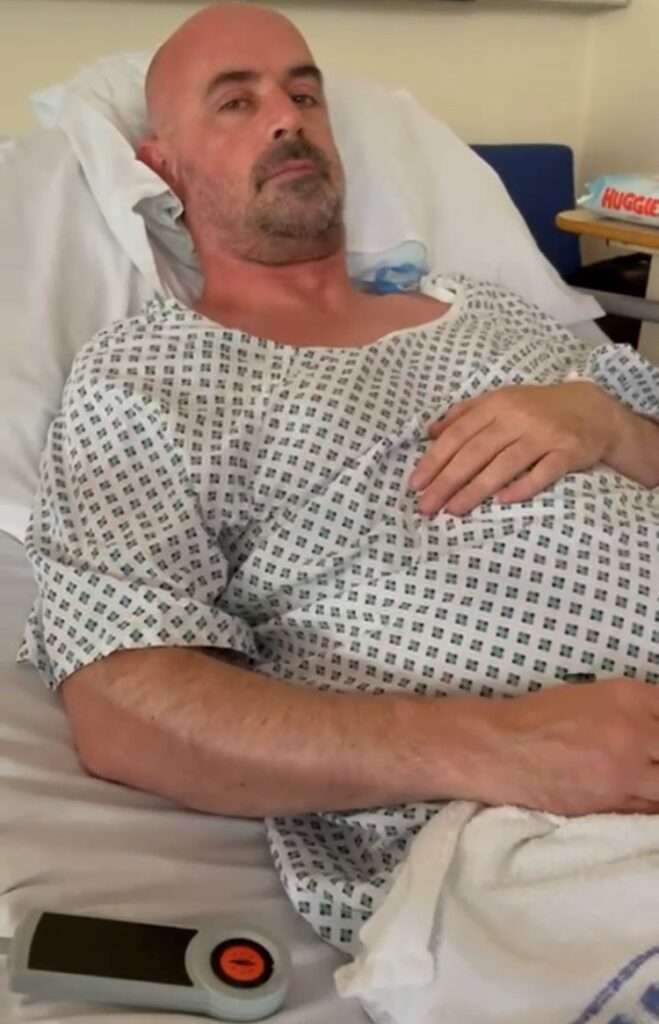
I didn’t reach my hospital bed in Salford until the early hours of Friday morning. It was some time later that morning that the neurosurgeon explained to me that I would need to undergo surgery, and that it would need to happen before I’d have a chance of seeing any visitors. We therefore set up a conference call on my phone with the surgeon explaining, as he had done to me, all about what had happened to me and what needed to happen now – listening on that call were my partner, parents and sister, who had all by now congregated at my parents’ house back in Wigan. I was very scared – we all were. But I knew what we needed to do, just as I had done on the conferencing call the previous day. We needed to do as we were being advised. That was going to be the best chance of survival and recovery, and it would eventually turn out to be the case going forward too. Follow the advice! The operation, which took around four hours on the Friday afternoon, was a success. I was allowed visitors for the first time that night and for the first time I allowed myself to relax. It was so good to see everyone – although the staff had done a fantastic job of keeping them all informed, I just wanted them to know from me that I was OK and that I was going to get better. But I didn’t get to see everyone. As I was on the neurosurgery ward, no children were allowed to visit, so I didn’t see my daughter again for nearly two weeks following the stroke. We spoke on the phone and videotelephony, so that she too could be sure I was OK.
And so began eight days of rest, recuperation and recovery. I didn’t know a lot about brain injury (and I still don’t), but I knew enough to know that the recovery needed to start immediately. I had to get my arm and hand working again. The hospital course of physiotherapy didn’t start straight away, so I just started it myself, with small movements here and there, starting with my fingers, thumb and wrist, and then attempting some basic arm movements, replicating day to day tasks – to get those neural pathways activated. At the start of my recovery, I had zero movement or control in my arm. In fact I suffered a focal seizure on the second and third days, which left my arm uncontrollably twitching, but by day four I was being treated with seizure medication and was already using my arm to pick up a plastic bottle and pretend to pour from it. I just kept on trying to use my right arm for all kinds of normal, everyday things; eating, showering, cleaning my teeth. I was gaining some basic control over my hand, but still no sensation, so I had to be very mindful and watchful whenever I used it. The concentration required for some very basic things was exhausting at times. Eventually, part way through that first week, the hospital physio and occupational therapy took over my recovery and began planning my return home.
Prior to my stroke I had suffered marriage breakdown and divorce. After a year or two back with my parents, I had begun re-building a new life and although in a new relationship, I was living alone and had been for nearly eighteen months. The hospital staff were very uneasy about the idea of me leaving hospital and being alone, but my best chance of a comfortable recovery was to be in my own home. There was a suggestion to move back in with my parents – they have the space and time to help me – but at their time of life, and with my dad’s own needs being my mum’s priority, I decided it was best not to increase their burden. My sister was also an option, but as she lives over a hundred miles away with her own family, so that would have made contact with my daughter very difficult indeed. In the end, there was only one sensible option, and my partner offered to take on the job of caring for me, which meant that she and her 15 year old daughter would have to move in with me – lock, stock and barrel – and over the course of one weekend! This monumental act of kindness and bravery is something I will never forget. We had previously discussed moving in together, but we were by no means at that stage just yet. There was still a lot to discuss and a lot to do. It was a big leap for my partner and her daughter, not to mention the adjustment for my own daughter, but it was something they were all willing to go along with, for the sake of my safety and recovery – and four months on, they’re still here and have taken root, along with their cat Smudge.
My recovery has continued in earnest ever since. With the help of an occupational therapist, a stroke nurse, my GP, charitable organisations, volunteers, fellow stroke survivors, friends, relatives and my new family, I am well on the way to where I need to be. We have continued following the medical advice and focussed attention on stimulating sensation in my arm and hand. Stroking, massaging, tickling, poking, prodding and stretching, to help re-wire those pathways and get the messages flowing between brain and arm. Fatigue has also been a huge factor. I initially relied on physical help or mobility aids to get around (particularly following an abandoned shopping trip to a local supermarket). The only way I can describe fatigue to those who aren’t familiar is that it’s not like your muscles are hurting, it feels like there’s an invisible force holding you back, and no matter how hard you try, you just can’t go any faster or further – like my body has shut down to protect itself. But after phasing out those aids and help, I am now able get around independently on foot, walking up to two miles at a time, and I’ve recently joined a walking football group once a week. It’s particularly vital for me that I’m able to get around independently, because the surgery and seizure meant that my driving licence was revoked for a minimum of six months from the date of surgery. I am now in the process of reapplying for it and am living in hope that I get the answer I need. I really feel like I’m missing out on some of the freedoms I used to have, but focussing on recovery and keeping away from work and driving, are going to ensure that I can continue to improve and secure those freedoms later on.