It was in this shared house that I had my first stroke. It was the middle of the night and I woke with the worst headache I had ever experienced. I had no other symptoms, took some pain pills and went back to bed. My girlfriend could not wake me properly in the morning but left for work as it was her first day at a new job. She was sufficiently concerned though to keep phoning me throughout the morning. Eventually, when she couldn’t get an answer on my mobile, she called the house phone. A flatmate answered, checked on me and told her I was fine, just sleeping. I recall my work calling me and me not being able to speak clearly to them. It was midday by the time my girlfriend got through to me on my mobile – and when I called her the wrong name and she realised I was not joking – she knew something was not right.
An hour later we were walking up to the GP surgery, still not aware of how serious things were. The surgery was closed so we headed in a taxi to the nearest A&E where it took some time to convince the doctors that I had not taken any drugs or been drinking. My words were coming out wrong or not at all. We were sent to Charing Cross Hospital and it was there that the doctors explained I had had a stroke due to an arteriovenous malformation (AVM) that had bled in my brain. When we asked how the doctor could be sure it had stopped bleeding he said if it had not, then I would be dead.
This was my first experience of stroke. I was 21 and suddenly in a hospital ward surrounded by much older people and unable to communicate. I had never heard of an AVM and the only stroke I was familiar with was heatstroke – not something you expect to get In England.
I had surgery to remove the AVM and a recovery period of about 2 weeks in hospital. Physically at that stage I was fine and the only therapy I required was Speech Therapy. While in hospital we decided that returning to the large shared house was not the best option and I moved to a smaller flat in the same area with my girlfriend and two closest friends. This was the start of my shrinking social circle. At least part of this was my own choice as I was embarrassed about seeing people when I could not speak properly.
I started seeing the speech therapist on a weekly basis and also travelled into London to the then charity UK Connect, where I met with a stroke survivor who was also a counsellor. I got back to travelling and three months after my stroke visited Paris with my girlfriend including enjoying rides at Disneyland. I was starting to think I would be able to return to my job in computers.
I have always been keen on exercise so had returned to the gym quite soon after my stroke. Three or four months after my stroke, I decided to introduce my girlfriend to the gym. I was explaining a piece of equipment to her when suddenly my words came out just a little slurred. It was enough of a change to make us a little concerned but not enough to stop us from walking the 10 minutes home. As I got back to the house and up to my bed to lie down my right arm and leg “went”. I can remember my fear as I realised I was having another stroke. I woke up in Charing Cross Hospital where I needed further surgery – a part of the AVM had apparently been hidden and not removed in my first surgery. This is something I still feel frustrated by. This stroke was major – it had even more of an effect on my speech, reading and writing but also left my right arm and right leg paralysed.
I spent two months in Charing Cross Hospital before being sent to the Regional Rehabilitation Unit in Northwick Park Hospital for another 8 months of rehabilitation. I received daily physio; occupational therapy and speech therapy. There was also psychology (something I am not a fan of) and art therapy. While the physiotherapist worked on normalising my tone I was not allowed to walk and spent several months in a powered wheelchair. My right hand did not recover movement and my therapy goals were then focussed on being able to walk. My speech, reading and writing were significantly limited. I struggled with names of people and objects. The OT (Occupational Therapist) tried to help me practise my writing on the computer but I required help to put the sentences in my head down in writing.
A third stroke halfway through my hospital stay resulted only in a major headache. It took several days of me complaining about it for the doctors to send me for a scan as they didn’t believe I would have had another stroke. But I was convinced. The scan showed another bleed and back they sent me to Charing Cross for yet another removal of a previously hidden part of the AVM.
This experience led me to worry a lot about headaches for the first few years after the last bleed. As time went by and I had “normal” headaches the worry lessened.
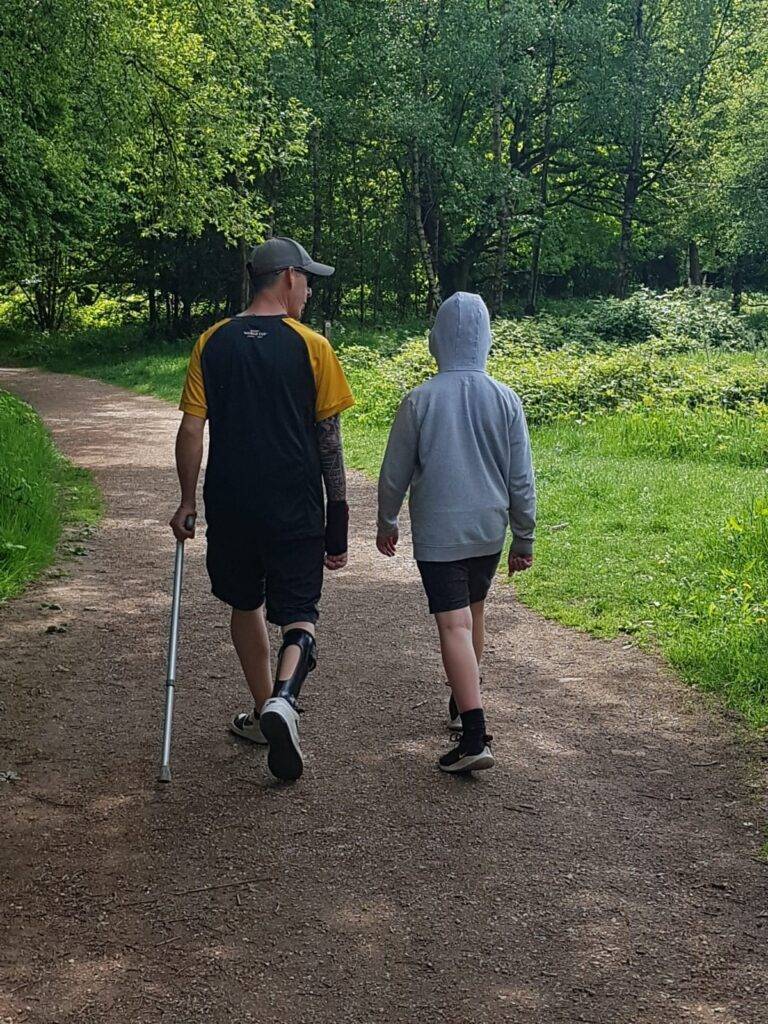
After discharge from the rehab unit I moved to Aylesbury where life would be a little quieter and easier than London. At that stage I was walking indoors but still being pushed in a wheelchair outdoors. I got to know my surroundings through trips to appointments on Dial-A-Ride – another service that has disappeared over the years.