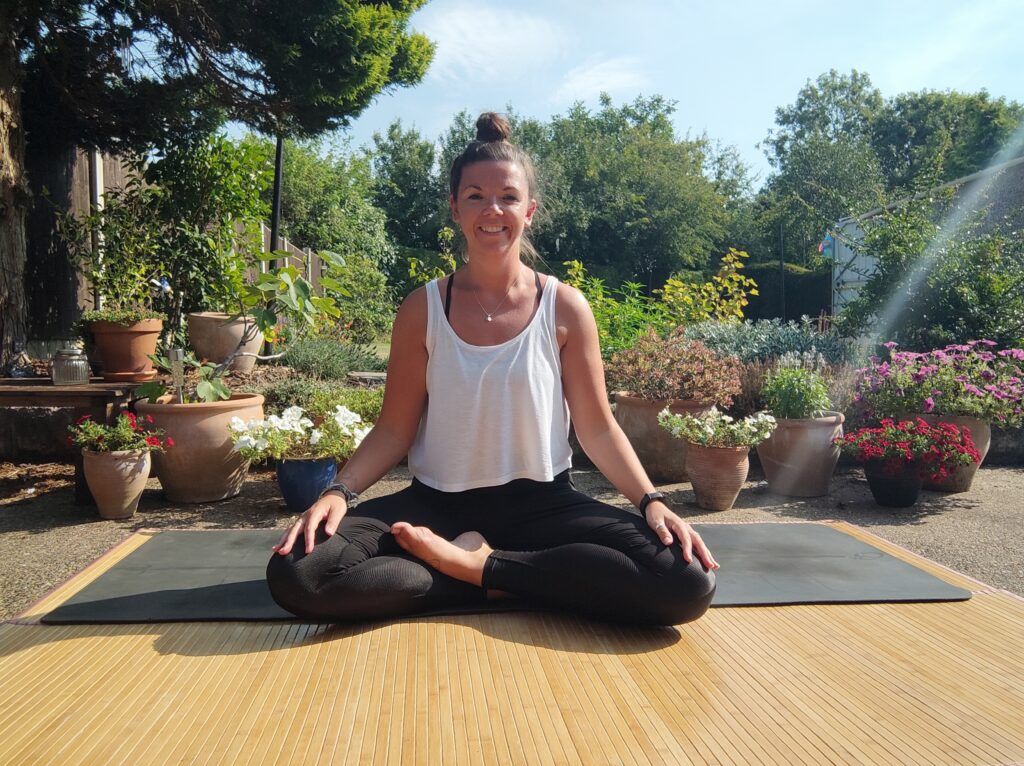

About Anna Kerry:
“I had a stroke aged 35 in March 2021. I’ve had a regular yoga practice for about 7 years. I decided I loved the practice so much that I wanted to learn how to teach and share my love of yoga. I qualified in August 2020 and had only been teaching for around 7 months when I had a stroke. As the stroke came out of the blue I had to dig deep into my yoga practice to help me through. I believe that my yoga practice has helped my mindset and my mental health during this traumatic time.”
Learning Your Triggers
As a yoga teacher, you might think that I never get stressed, right? Wrong, we all get stressed at some point in our lives but what’s important is how we deal with that stress.
I know that a stroke can be brought on by stress. If you have had a stroke that has been related to stress this can be an opportunity for you to make life changes. But what if you don’t know you are stressed? how then can you deal with your stress before it becomes a problem? You might even think that you’re not stressed.
It can be difficult for many to recognise the signs of stress, due to the world being so loud and busy. We tend to push ourselves to the bottom of our priority list, we can forget that we need to take care of ourselves too.
There are lots of different signs of stress and these all show up differently in your body; irritability, aggressiveness, anxiousness, difficulty relaxing, feeling overwhelmed or difficulty concentrating to name a few.
It’s important to be able to notice the first signs of stress so that it can be managed. So now let’s look at a few things that can help you to recognise and deal with stress.
You will notice one thing about the signs of stress and that is, the breath changes in all of those circumstances. It becomes shallow and in some circumstances can quicken.
Tuning in to your breath is a quick way to notice how you are feeling. If your breathing is calm your body will feel relaxed, if your breathing is fast and shallow your body will feel tense.
Recognising your triggers of stress is really important for you to be able minimise stress within your life. I’m not saying you need to lock yourself away, we can’t avoid stress in our lives but if you can recognise what triggers stress then you will be better prepared to deal with it.
I think it’s also important to recognise here that having a stroke in itself is an incredibly stressful experience. Recovery can also be a stressful time. You may find yourself getting frustrated, wishing for your ‘old’ life and self back. There are practices that you can put in place to help you to deal with this.
Listening to your body
My number one go-to is learning how to listen to my body and its needs. Since having a stroke, this more than anything has been a game-changer for me.
To be able to tune in and listen to your body and its needs is incredibly important. It can be as simple as laying your hand on your heart, taking a deep breath, and actually asking yourself what you need at that moment. We need to stop thinking that self-care is selfish, I’m sure you’ve all heard the phrase when you’re listening to the safety briefing on an airplane about fitting your own oxygen mask first. The main point of that is you can’t help other people if you don’t help yourself first. To allow yourself this time to check in with how you feel is so important for your wellbeing. Even if you give yourself 5 minutes every now and then throughout the day. You can even set yourself a reminder on your phone to do this! This may seem like a small and simple thing to do but I’ve found that it’s the small things that you can do often which make the biggest impact.
If you find it difficult to connect to your body you might want to try a yoga practice. Connecting to your body and your breath as you move can be a great way to release tension from your body. There are also great classes out there now for people with limited mobility, I believe that everyone should be able to access a yoga class – there are so many proven benefits to doing yoga. When I was in hospital one of the doctors told me to try meditating to help me through the traumatic experience. As a yoga teacher, I practiced meditation regularly, however, I found that after having a stroke it was difficult for me to sit in stillness with the thoughts going through my head, meditation was hard! I’ve since found out that when you have been through trauma sitting in stillness might not be the most helpful thing you. I used my yoga practice as a moving meditation which helped me through the early stages of my recovery. I was lucky to regain my movement early on in my recovery but you can still move your body if you have limited mobility. I did lots more floor-based movement to start with as I was gaining my strength back.
"Your Feelings and Emotions are Like the Weather, They Come and Go. Your True Self is the Sky
Once you have learned to recognised that you feel stressed it can be easy to say ‘I’m so stressed’ or ‘I’m really overwhelmed’ by phrasing it in this way we automatically tell ourselves that this is who we are and that’s when it can become all-consuming. If you instead, phrase it as ‘I feel stressed’ or ‘I feel overwhelmed’ it tells you instantly that this is a feeling. Phrasing things differently can allow you to give yourself space from your feelings. This isn’t about avoiding your feelings it’s only about giving yourself some space from the feelings and emotions that can feel all-encompassing and allowing you to deal with them. Once you give yourself space from your feelings you can begin to understand that this feeling isn’t the whole of you. One of my favourite phrases is ‘your feelings and emotions are like the weather, they come and go. Your true self is the sky’. The meaning behind this phrase is that you are not your feelings and that they are temporary. Beneath all the feelings, emotions, and labels we give ourselves is our true self.
The next time you find yourself in an experience where your breath changes and becomes shallow or quickens notice what the situation is and take a moment to notice what you feel within your body. Does your heart rate feel fast, do your palms feel sweaty or does your body feel tense? This is your body’s automatic reaction to stress. Learn to notice these and you’re well on your way to dealing with stress in a healthy way.

Different Strokes Glasgow Peer Support Group Returns
Different Strokes is delighted to announce the return of its Glasgow Peer Support Group, providing a welcoming space for working-age stroke survivors, their families and

30 Years of Different Strokes:A Day of Connection, An Evening of Celebration
On Saturday 18th July, over 100 people gathered in Northamptonshire to mark 30 years of Different Strokes. Reclaiming Life After Stroke The day opened with

Upcoming Webinar: Looking After Yourself While Caring for Someone After Stroke
Free Webinar | Wednesday 22 July | 11:00am When someone you love has a stroke, life can change in an instant. Partners, spouses and family

Bringing the Stroke Community Together in London
During June we hosted a Community Event in London at the offices of Bolt Burdon Kemp.

Free Webinar: Medical Negligence & Rehabilitation After Stroke
Different Strokes is pleased to be partnering with specialist medical negligence law firm Fletcher’s Solicitors to offer a free online webinar for stroke survivors, families and carers.

Mike Caines Wins the 2026 Different Strokes Outstanding Contribution Award
Mike Caines Wins Different Strokes’ Outstanding Contribution Award 2026 For the past 14 years, Mike Caines has been a quiet constant behind Different Strokes. He